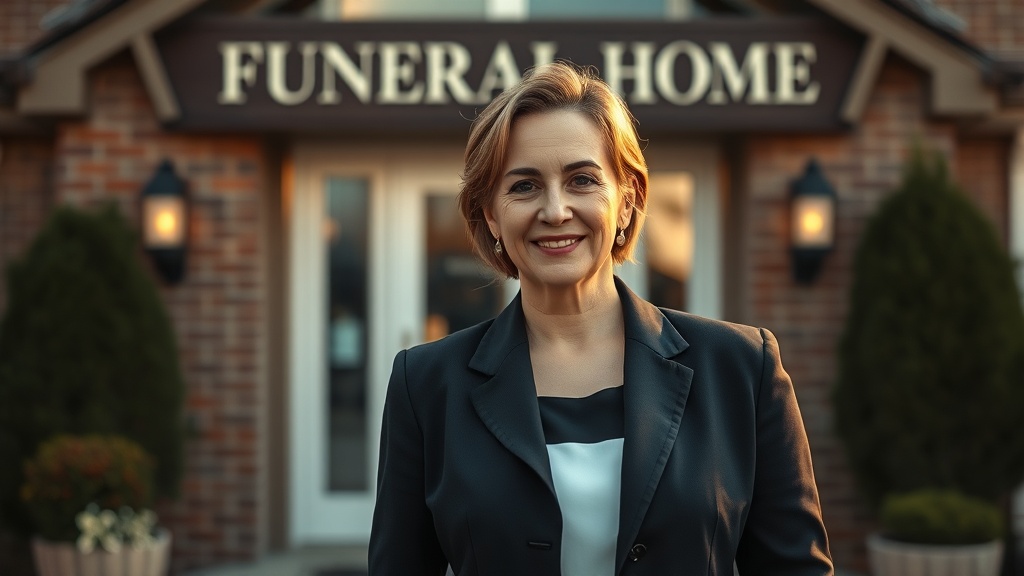
From 70-Hour Weeks Running a Restaurant to Dressing the Dead: How One Burned-Out Manager Found Peace in Funeral Service
From 70-Hour Weeks Running a Restaurant to Dressing the Dead: How One Burned-Out Manager Found Peace in Funeral Service
Nobody plans to become a funeral director. That's what Renee Alvarez told me within the first two minutes of our conversation, and she said it like someone who's had to explain this to every person at every dinner party for the last six years.
"You tell people you embalm bodies for a living and they either want to hear every single detail or they physically back away from you," she said. "There is no middle reaction."
Renee is 39, lives in Albuquerque, New Mexico, and has been a licensed funeral director and embalmer for five years. Before that, she spent eleven years in restaurant management — the last four as the general manager of a mid-range Italian place that did 300 covers on a Saturday night. She made $58,000 a year, worked 65 to 75 hours a week, and hadn't taken a real vacation since 2016.
"I was good at it," she said. "That was the problem. I was good at managing chaos. Keeping forty employees in line, handling angry customers, dealing with a walk-in cooler that broke at 4 p.m. on a Friday. I could do all of that. But I was also having panic attacks in the parking lot before my shift, so."
The Pivot Nobody Saw Coming
The decision started with a death, which I suppose is fitting. Renee's grandmother passed away in early 2019, and at the viewing, she found herself watching the funeral director more than she was watching the guests.
"He was so calm," she said. "Not detached — calm. He moved through this incredibly emotional situation with purpose. He knew exactly what to do, exactly what to say. And I thought, that's a skill. That's a real, valuable skill."
Two months later, she Googled "how to become a funeral director" at 2 a.m. after closing out the restaurant. Within a week, she had applied to the mortuary science program at a community college in Santa Fe. The program was 18 months and cost about $14,000 in tuition.
"My mom thought I was having a breakdown," Renee said. "My friends thought it was some kind of dark joke. My boss at the restaurant said, and I'm quoting directly here, 'You want to do what?'"
What Mortuary School Is Actually Like
Mortuary science programs are accredited through the American Board of Funeral Service Education. There are about 60 accredited programs in the U.S. Most are associate's degrees, though some schools offer bachelor's programs. Renee's was an associate's — 70 credit hours, four semesters, plus a one-year apprenticeship after graduation.
The coursework isn't what people expect. Yes, there's embalming lab, and yes, you work on real human remains. But the majority of the program is business law, accounting, grief counseling, ethics, anatomy, microbiology, and regulatory compliance.
"The embalming part is honestly the smallest piece," Renee said. "You learn the chemistry, the technique, the restorative art. But most of your time is spent learning how to run a funeral home as a business, how to counsel families, how to navigate state and federal regulations. There are so many regulations."
She attended classes during the day and bartended three nights a week to pay the bills. Her income dropped from $58,000 to roughly $22,000 that first year. She burned through about $11,000 in savings.
"I ate a lot of rice and beans," she said. "I'm not going to romanticize it. It was tight. But it was also the first time in years where I felt like I was building something instead of just surviving."
The Apprenticeship: Where It Gets Real
New Mexico requires a one-year apprenticeship under a licensed funeral director before you can sit for the licensing exam. Renee's apprenticeship paid $15 an hour — about $31,000 a year — at a family-owned funeral home in Albuquerque.
"Your first embalming is something you never forget," she said. "Not because it's horrifying — because it's profoundly intimate. You are caring for someone's body after they can no longer care for themselves. That reframe changed everything for me."
During the apprenticeship, she handled around 200 cases. She learned to coordinate with hospitals, medical examiners, clergy, florists, and cemeteries. She learned to have difficult conversations about money with grieving families — conversations that happen, by necessity, within 24 to 48 hours of a death.
"In the restaurant, I dealt with complaints about overcooked pasta. Here, I'm sitting across from a widow who just lost the person she's been married to for 40 years, and I have to explain that the casket she wants is $8,000. You develop a very specific kind of empathy."
The Numbers
Let's talk money, because I know that's why a lot of you are here.
The Bureau of Labor Statistics puts the median annual wage for funeral directors at about $49,800 as of May 2024. But that number is misleading, and Renee's experience shows why. Funeral home managers — which is what you become after a few years — earn a median of $76,830. In metro areas, experienced directors can clear $85,000 to $100,000. Own your own home? The ceiling goes higher.
Renee currently makes $68,000 as a full-time funeral director at the same home where she apprenticed. She's been there three years post-licensure and expects to hit $75,000 within the next year or two as she takes on more management responsibilities.
Here's how that breaks down compared to her restaurant career:
- Restaurant GM salary: $58,000 for 65-75 hours/week (works out to roughly $16/hour)
- Funeral director salary: $68,000 for 45-50 hours/week (roughly $28/hour)
- Benefits: Health insurance, two weeks PTO, retirement match — none of which she had at the restaurant
"I make more money, work fewer hours, and actually have health insurance for the first time since I was on my parents' plan," she said. "The math isn't even close."
What Nobody Tells You About the Job
It's not the dead bodies that are hard. Renee was emphatic about this. The bodies are the straightforward part.
"The hard part is the living people," she said. "It's the family members who are angry because grief makes people angry. It's the adult children who haven't spoken in twenty years and now have to plan a funeral together. It's the mother who lost a child and you have to stay composed because she needs you to be composed."
The hours can be unpredictable. Deaths don't happen on a schedule. Renee is on call one weekend a month and two weeknights a week. When the phone rings at 3 a.m., she goes. But unlike the restaurant, she doesn't work every weekend. She doesn't work every holiday. She has actual, predictable time off.
"I went on vacation last year," she said, and the way she said it — like it was still surprising to her — told me everything about what her restaurant years were like.
There's also the emotional weight. Renee sees a therapist every two weeks, which she considers a non-negotiable professional expense. "You can't absorb that much grief without somewhere to put it," she said. "The funeral directors who burn out are the ones who think they can just power through. You can't."
The Industry Is Desperate for People
Here's the part that should interest anyone reading this who's thinking about their own career. The funeral industry has a staffing problem. The National Funeral Directors Association has been sounding the alarm for years — enrollment in mortuary science programs has dropped, the average age of funeral directors is climbing, and the death rate in the U.S. is projected to increase as the Baby Boomer generation ages.
Translation: there are jobs. Good ones. In almost every state.
"I had three job offers before I even finished my apprenticeship," Renee said. "That doesn't happen in most fields right now."
The barrier to entry is real but manageable. You're looking at about 18 months to two years of school, a one-year apprenticeship in most states, and then a national board exam plus your state licensing exam. Total investment in time: roughly three years from decision to licensed director. Total investment in money: $14,000 to $33,000 for tuition, depending on the program.
What She'd Tell Someone Considering It
I asked Renee what she'd say to someone who's burned out in their current career and considering funeral service.
"First, go to a funeral home and ask to shadow for a day," she said. "Most directors will let you. See the prep room. Watch an arrangement conference. See if you can handle it — not the gore, because honestly there isn't much, but the sadness. Can you be around sadness all day and still be okay? That's the real question."
"Second, check your state's requirements. They vary a lot. Some states only require you to be a licensed funeral director to arrange services. Others require you to be a licensed embalmer too. Know what you're signing up for."
"Third — and this is the big one — ask yourself if you're running away from something or running toward something. I was doing both, honestly. I was running away from the restaurant industry and running toward something that felt meaningful. But if you're only running away, you'll burn out in this field too. You have to actually want to do the work."
The Part That Surprised Her Most
I always ask people what surprised them about their career change. Renee's answer was instant.
"How much I laugh at work," she said. "People think funeral homes are these somber, quiet places where everyone whispers. And sometimes they are. But also, we are regular people who eat lunch together and tell jokes and have birthday parties in the break room. Death is part of life, and once you accept that — really accept it — you stop being weird about it."
She paused, then added: "The restaurant industry almost destroyed me. This career gave me my life back. I know that sounds dramatic, but I mean it literally. I sleep now. I eat regular meals. I see my friends. I'm a better person than I was five years ago, and it's because I spend my days helping people through the worst moment of their lives instead of worrying about table turn times."
Renee Alvarez dresses the dead for a living, and she has never been more alive. I know she'd hate that I wrote that, but I'm leaving it in anyway.
Career Stories profiles real people navigating real career changes. If you've made a major career pivot and want to share your story — with the actual numbers — reach out at marcus@careerstories.blog.