The $90K Career Nobody Talks About: Inside the Disappearing World of Court Reporters

The $90K Career Nobody Talks About: Inside the Disappearing World of Court Reporters
There are 23,000 stenographers left in the United States. A decade ago, there were almost 30,000. Half of the ones still working are close to retirement age. And the courts can't function without them.
I found Danielle Okafor through a professional listserv where court reporters vent about scheduling chaos. She'd posted a thread titled "Three depositions, two cancellations, one migraine" and half the replies were just people saying "same."
Danielle is 41, lives in Columbus, Ohio, and has been a freelance court reporter for fourteen years. She clears about $92,000 in a good year — sometimes more, sometimes less, depending on how many depositions land on her calendar and how fast she can turn transcripts around.
"People hear 'court reporter' and they picture someone sitting silently in a courtroom typing on a weird little machine," she told me over a video call. "That's maybe thirty percent of what I actually do."
The Machine Isn't a Keyboard
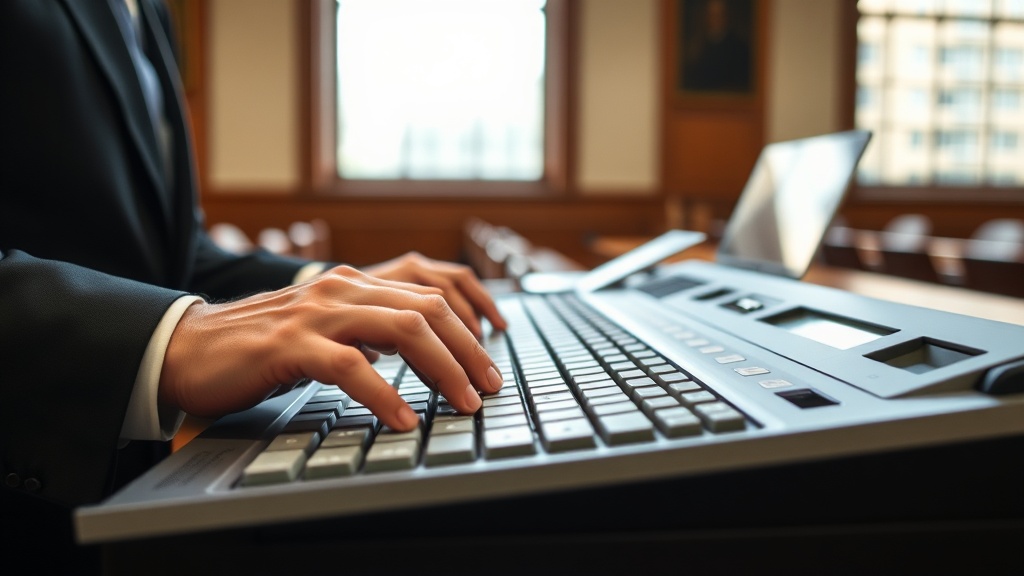
Let's get this out of the way: a stenotype machine has 22 keys, and you press multiple keys at once to form syllables and words, not individual letters. It's closer to playing chords on a piano than typing on a laptop. Experienced reporters can capture speech at 225 words per minute or faster. The average person speaks at about 150.
Danielle learned on a Diamante stenotype machine, which runs about $4,500. Her current setup — a Luminex II — cost her $5,200. She also pays for realtime software (about $3,000 for the license), a laptop, audio backup equipment, and a rolling case that she hauls into law offices and courtrooms across central Ohio.
"Before you make a dollar, you're probably eight, nine thousand into equipment," she said. "And that's before the years of school."
The School Nobody Finishes
This is the part that surprised me most.
Court reporting programs — usually offered at community colleges or specialized trade schools — take an average of 33 months to complete. But the dropout rate is brutal. The National Court Reporters Association estimates that only about 15 to 20 percent of students who start a stenography program actually finish and pass the certification exam.
Danielle went through a two-year program at a community college in Akron. It took her three and a half years.
"The speed tests are what kill people," she said. "You have to pass a five-minute test at 225 words per minute with 95 percent accuracy. Some people sit in that speed class for years and never hit it. You watch classmates just... disappear."
She passed on her fourth attempt. Then she took the Registered Professional Reporter exam, which is the baseline national certification. Then the Ohio state certification. Then she started looking for work.
"I had a job within a week," she said. "That's how bad the shortage is."
The Shortage Is Real and It's Getting Worse
The numbers are stark. The stenographer workforce has declined 21 percent over the last decade. California alone reported a shortage of 458 full-time court reporters in 2026. Courts in rural areas across the country are struggling to find anyone at all.
The Bureau of Labor Statistics puts the median salary for court reporters and simultaneous captioners at about $67,310 nationally, but that number masks enormous variation. Official court reporters — the ones employed full-time by a court — tend to earn steady salaries with benefits, often in the $55,000 to $75,000 range. Freelancers like Danielle, who work depositions and hearings on contract, can earn significantly more if they're fast and reliable.
"My best month ever was $14,200," Danielle said. "That was three complex patent litigation depositions back to back, rush transcripts on all of them. Rush rates are where the real money is."
Rush transcript fees can double or triple the base page rate. A standard transcript might pay $3.50 to $5.00 per page. A rush job — delivered in 24 hours instead of the typical ten business days — can pay $8 to $12 per page. A 200-page deposition at rush rates adds up fast.
A Tuesday in Danielle's Life
I asked Danielle to walk me through an actual workday. She picked a Tuesday from two weeks earlier.
6:15 a.m. — Alarm. She checks email on her phone before getting out of bed. One attorney has moved a 9 a.m. deposition to 10. Another has confirmed a 2 p.m. She updates her calendar.
7:30 a.m. — She loads her car: stenotype machine, laptop, audio recorder, backup batteries, a power strip ("never trust a conference room outlet"), and a folder with case names and spellings she prepped the night before.
8:45 a.m. — Arrives at a downtown Columbus law firm. Sets up in a conference room. Tests her equipment. The attorneys trickle in. The witness — a former employee in a wrongful termination case — looks nervous.
10:05 a.m. — The deposition starts. She's writing in real time, her fingers pressing chord combinations while she listens to every word. When two people talk over each other, she has to capture both. When someone mumbles, she stops them. She's the only person in the room with the legal authority to put witnesses under oath.
"People forget that part," she said. "I'm not just a transcriber. I'm an officer of the court. I administer the oath. The record I create is the official legal record. If I miss something, it can affect the outcome of the case."
12:40 p.m. — Deposition ends. She packs up, eats a sandwich in her car, and drives twenty minutes to the next location.
2:15 p.m. — Second deposition begins. This one is a medical malpractice case. The terminology is dense — she prepped a word list the night before so her software would recognize terms like "laparoscopic cholecystectomy" and "trocar insertion site."
5:10 p.m. — Second deposition wraps. She drives home.
6:30 p.m. — After dinner, she spends two hours editing the transcript from the morning deposition. Her software captured the raw steno notes; now she's cleaning up formatting, checking spellings, making sure every "Q" and "A" is properly attributed. She'll spend another two hours on the second transcript tomorrow.
"The deposition is half the job," she said. "The transcript production is the other half. People don't see that part."
The Digital Debate
Here's where it gets contentious.
With the shortage worsening, some courts are turning to digital court reporting — using audio recording equipment and a trained monitor instead of a live stenographer. The American Association of Electronic Reporters and Transcribers has been pushing this model hard, arguing it's the only scalable solution.
Stenographers, predictably, aren't thrilled.
"Digital reporting has its place," Danielle said carefully. "But I've seen the transcripts. When you have a four-hour hearing with bad acoustics, multiple speakers, and a witness who whispers, a recording doesn't cut it. Someone still has to sit and transcribe that audio. And the turnaround is slower, and the accuracy is lower."
She's not wrong about the turnaround. Studies from the NCRA show that stenographic reporters can produce same-day rough drafts — called "realtime" — while digital reporters typically need days to produce a finished transcript from audio.
But she's also honest about the math.
"There aren't enough of us. Full stop. Courts are canceling proceedings because they can't find a reporter. Cases are being delayed. That's not good for anyone. If digital fills some of those gaps, fine. But the idea that AI transcription is going to replace what I do in a complex deposition? Not yet. Maybe not for a long time."
What AI Actually Does (and Doesn't Do) Here
I asked about AI because everyone asks about AI.
Danielle uses AI-assisted software to help with her transcript editing — it flags potential errors, suggests corrections, and helps with formatting. She estimates it saves her about 30 minutes per transcript.
"It's a tool," she said. "Like spell-check for steno. It doesn't replace my ears, my judgment, or my ability to stop a witness and say 'I'm sorry, could you repeat that?' A recording can't do that. An AI can't do that."
She paused. "Also, try getting an AI to correctly attribute dialogue when four attorneys are talking over each other about a patent claim involving semiconductor wafer bonding techniques. Good luck."
The Money Breakdown
Danielle shared her numbers from 2025:
- Gross income: $94,300
- Equipment and software: -$2,800
- Continuing education and certification renewal: -$1,200
- Health insurance (self-purchased): -$7,800
- Gas and vehicle expenses: -$4,100
- Self-employment tax (estimated): -$13,300
- Net after expenses and SE tax: ~$65,100
"That's real money in Columbus," she said. "I own my house. I have no student debt — the community college program was cheap. I set my own schedule, mostly. If I want a week off, I just don't take jobs that week."
She also pointed out something that job-satisfaction surveys rarely capture: she's never bored.
"Every deposition is a different story. One day it's a construction accident. Next day it's an intellectual property fight between two pharmaceutical companies. I've sat through testimony about helicopter crash investigations, restaurant health code violations, and a custody dispute involving a pet parrot. You can't make this stuff up."
Who Should Actually Consider This Career
I asked Danielle who she'd recommend this path to.
"Someone who can sit still and focus for hours. Someone who likes language — not creative writing, but precision. Someone who doesn't need to be the center of attention but wants to be essential. And someone who can handle the school part, because that's where most people wash out."
She was quiet for a second.
"Also, someone who's okay with being invisible. I'm in the room for the most important moments of people's legal lives, and they almost never look at me. I'm part of the furniture. That bothers some people. It doesn't bother me. I'm the reason there's a record."
The Part That Sticks
Before we hung up, I asked Danielle what moment in her career she thinks about most.
"There was a wrongful death case, maybe six years ago. The plaintiff was the mother of a young man who'd been killed in a warehouse accident. During the deposition, she started talking about the last time she saw her son — he'd come over for dinner and fixed her garbage disposal before he left. She broke down."
"Everyone in the room went quiet. The attorneys, the videographer, everyone. And I just kept writing. Because that's my job. Her words are in the record. They mattered in the case. And later, when the family's attorney read that passage back during the trial, it was exactly right. Every word."
She cleared her throat. "That's why this job matters. That's why a machine can't just replace it. Someone has to be there, paying attention, getting it right."
There are 23,000 people left in America who do that. If you've got the hands, the focus, and the patience to survive the training, there's a chair waiting for you.